


As sport and training ramp up this time of year, many athletes and recreational exercisers begin increasing their running volume, intensity, and frequency. While building fitness is essential for performance, doing too much, too soon is a common reason people develop injuries.
What kinds of injuries are load related?
Understanding how your body responds to training load (and recognising the early warning signs of overload) is key to staying healthy, consistent, and enjoying your sport. Two of the most common load-related injuries we see in running athletes include:
Bone stress injuries: These occur when bones are exposed to repeated stress without adequate recovery time. Risk can vary based on age, training history, and sex, but adult runners of all levels can be affected.
Tendon injuries: Whether it’s the Achilles, hamstring, or other tendons, these injuries develop when tissues are exposed to training loads they are not yet conditioned to handle. Tendons adapt slowly, making gradual progression and recovery essential.
By managing your training load appropriately and building capacity over time, you can reduce injury risk and improve performance.
How do these injuries occur?
Tissue injury most commonly occurs when training load changes too quickly, either increasing or decreasing beyond what your body is currently prepared to tolerate. Every tissue has a certain capacity, and when load exceeds (or suddenly drops below) this threshold, the risk of injury rises.
This is why the relationship between your regular training load and recent changes in volume or intensity is so important. In simple terms, your body adapts to what it does consistently, and sudden spikes or drops in training can overload tissues that haven’t had time to adjust.
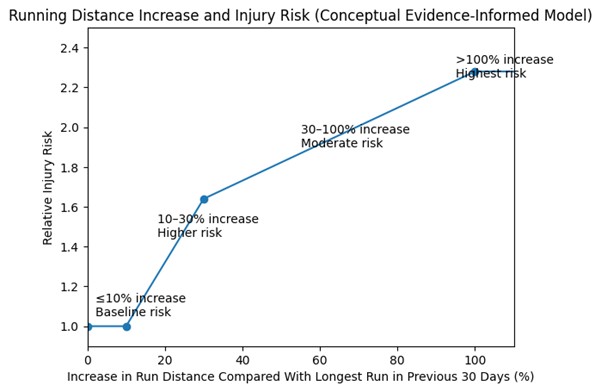
In a new study (Frandsen et al 2025), increased load from a single session is considered. The largest study of its kind concluded that amongst distance runners, increases in load more than 10% of the longest run in the past 30 days was an indicator for overuse injury. Particularly, the rate of injury risk is of significantly high likelihood in those who doubled (>100%) their load of a normal run. For example, if an athlete usually runs two 10km sessions per week for the past month, and decides to run 15km for just one session, their risk of injury could be up to 52%. This is something to consider in your programming, particularly if it has not been tailored to you by a professional.
It’s also important to remember that sudden reductions in training load can still increase injury risk. In winter sports especially, physiotherapists often see a spike in injuries after holiday periods, when athletes return to high-intensity training following weeks of reduced activity. In these cases, it is important to consider professional guidance for appropriate reloading strategies.
Some further things to consider: how are you feeling during these weeks of loading? Is stress from work impacting your heart rate and energy? Have you just had a great day and proceeded to run an extra 5km on top of your normal session? Internal load (how you feel, heart rate, etc.) is just as important to consider as mileage and environment.
What should I look out for?
• Pain on impact (running, hoping, prolonged walking)
• Constant dull ache
• Pain that improves as you warm up, then comes on after the session
• Night pain
When should I seek advice?
Some running injuries can lead to severe dysfunction, such as stress fractures, so follow up with a health practitioner is advised. If you are a runner experiencing any night pain or pain with every step – enquire promptly with a GP with Sports medicine experience.
Preventing injury with adequate load management and strength & conditioning is gold standard care to avoid running-related, load driven injuries.
Additionally, if you have a concern about pain and performance as a runner or athlete, consider speaking to one of our physios in a free 10-minute phone consultation.
Written by: Sophie Jones (Physiotherapist)
References:
Article referenced in blog: Schuster Brandt Frandsen J, Hulme A, Parner ET, et alHow much running is too much? Identifying high-risk running sessions in a 5200-person cohort studyBritish Journal of Sports Medicine 2025;59:1203-1210. https://bjsm.bmj.com/content/59/17/1203.citation-tools
Hulin BT, Gabbett TJ, Lawson DW, Caputi P, Sampson JA. The acute:chronic workload ratio predicts injury: high chronic workload may decrease injury risk in elite rugby league players. Br J Sports Med. 2016 Feb;50(4):231-6. doi: 10.1136/bjsports-2015-094817. Epub 2015 Oct 28. PMID: 26511006.
Drew MK, Finch CF. The Relationship Between Training Load and Injury, Illness and Soreness: A Systematic and Literature Review. Sports Med. 2016 Jun;46(6):861-83. doi: 10.1007/s40279-015-0459-8. PMID: 26822969.
Moving Beyond Weekly “Distance”: Optimizing Quantification of Training Load in Runners
Max R. Paquette, Christopher Napier, Richard W. Willy, and Trent Stellingwerff
Journal of Orthopaedic & Sports Physical Therapy 2020 50:10, 564-569